 HappyHorse Model
HappyHorse and Alibaba: What the Evidence Shows
If you are searching for happyhorse alibaba connection evidence, the clearest answer is that current reporting points to an Alibaba link, but the exact corporate and product relationship is still not fully documented in the sources available.
HappyHorse Alibaba connection evidence: the short answer
What current reporting says
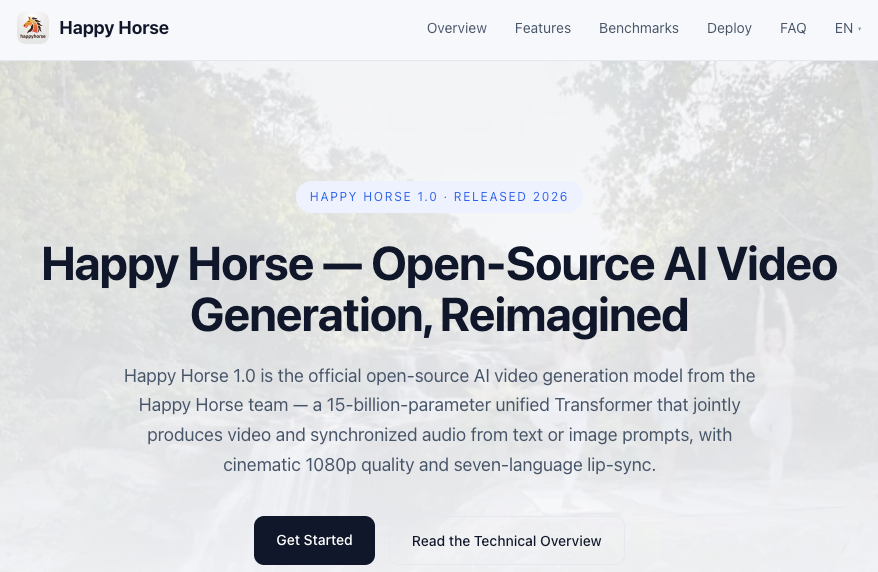
The practical bottom line is simple: several current discussions and posts describe HappyHorse-1.0 as Alibaba-linked or Alibaba-associated, and that is the most defensible summary based on the material available right now. If you just need the usable answer fast, treat HappyHorse as Alibaba-linked in ongoing reporting, not as a fully documented, officially mapped product line with every corporate layer confirmed.
Two specific claims show up repeatedly in the source set. First, a Reddit thread in r/StableDiffusion says “HappyHorse-1.0… comes from Alibaba’s Taotian Group.” That matters because it is more specific than vague “China big tech” speculation; it names a particular Alibaba business group. Second, a post from @AngryTomtweets says “now official: HappyHorse belongs to Alibaba” and adds that Zhang Di is leading it, with Zhang Di identified there as the former head of the Keling team. If you are mapping references quickly, those are the two clearest Alibaba-association claims in the notes.
That current reporting lines up with the way HappyHorse-1.0 has been discussed in AI video circles: not just as an anonymous model, but as a model that people increasingly connect to Alibaba as it climbed attention charts. When you see people summarizing the story in one sentence, this is usually what they mean.
What remains unconfirmed
The caution is just as important as the headline. One source explicitly says there is “No direct evidence connects HappyHorse to Alibaba’s WAN family” and notes that the Artificial Analysis ranking people keep citing is based on blind user voting, not official vendor disclosure. That means the ranking may tell you the model impressed users, but it does not prove ownership, parent company structure, or product-family lineage.
So if you are trying to state the relationship accurately, use careful wording. The safest phrasing is that the happyhorse alibaba connection evidence supports an Alibaba link in current reporting and discussion. The less safe phrasing is to say HappyHorse is definitively part of Alibaba’s WAN family or to present the exact internal org chart as settled fact. The source material provided simply does not close that gap.
A useful conclusion for day-to-day discussion is this: HappyHorse appears Alibaba-associated based on current reporting, including references to Taotian Group and a claim naming Zhang Di, but a fully verified WAN-family relationship is not established in the available material. If you are posting, writing, or briefing others, that wording stays accurate without overreaching.
What the evidence actually consists of and how strong it is
Primary signals vs secondary signals
To judge the happyhorse alibaba connection evidence correctly, it helps to sort what people are citing into source types. Right now, the claims circulating come from social posts, Reddit discussions, leaderboard commentary, and analysis articles. Those are not all equal, and mixing them together is where confusion starts.
Social posts are often the fastest signals. The @AngryTomtweets post is a good example: it is specific, names Alibaba, and even identifies Zhang Di as the lead. That gives you a concrete lead to investigate, especially if you want to search for Zhang Di across company-linked channels, conference appearances, or Chinese-language reporting. But a social post is still a social post. Unless it links to a company statement, release page, or verifiable corporate account, it should be treated as a directional clue rather than final proof.
Reddit discussions work the same way. The r/StableDiffusion claim that HappyHorse-1.0 comes from Alibaba’s Taotian Group is useful because it provides a precise attribution readers can test. Search value is high; evidentiary weight is lower. Forum claims can surface real leaks, insider chatter, or early product IDs, but they can also repeat unverified assumptions at scale.
Analysis articles sit one level above that when they cite sources and explain limits. The source titled “What Is HappyHorse-1.0? The Mystery #1 AI Video Model” is especially useful because it does two things at once: it acknowledges why people connect HappyHorse to Alibaba, and it explicitly warns that there is no direct evidence tying HappyHorse to Alibaba’s WAN family in the provided material. That kind of caution increases trust.
How to rank each source
A practical source-ranking framework makes this much easier. Use this order whenever you are checking AI model ownership claims:
- Official statement from the company
- Product page or release page with branding
- Model card or technical documentation
- Company org reference or employee profile tied to the product
- Third-party reporting with named sourcing
- Community discussion such as Reddit, X posts, or Discord summaries
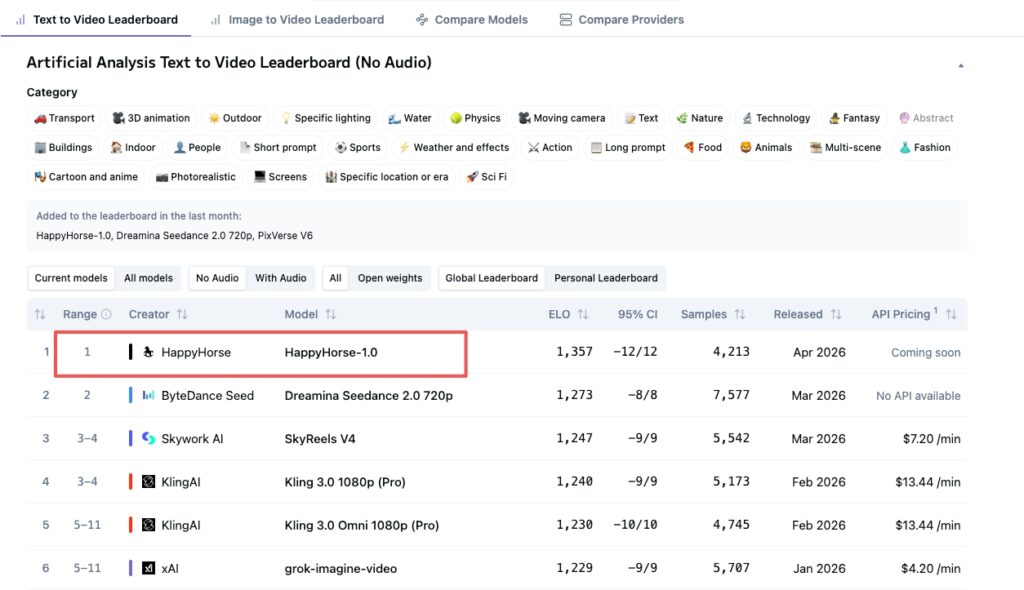
That framework matters because the Artificial Analysis leaderboard, while useful for output comparisons, does not verify ownership. The relevant source says the ranking is based on blind user voting. That can help assess perceived visual quality or preference strength, but it cannot confirm whether HappyHorse belongs to Alibaba, Taotian Group, WAN, or another internal effort.
So when you are scanning claims, separate two questions: “Does this model look strong?” and “Who exactly owns or operates it?” Blind voting may answer the first. It does not answer the second. If you keep those lanes separate, you avoid turning performance chatter into corporate certainty.
Why HappyHorse-1.0 drew attention in AI video generation

Leaderboard performance
HappyHorse-1.0 got traction for a very practical reason: people started talking because it reportedly reached the top of the Artificial Analysis leaderboard and was described as significantly outperforming products in the source material attributed to Longbridge. That is the kind of ranking result that instantly changes the conversation around a model. Once a new name starts beating familiar systems in side-by-side preference tests, everyone wants to know who built it, whether it is public, and how to access it.
That leaderboard momentum is the core reason the model stopped being obscure. In AI video generation, especially where quality differences show up immediately in motion coherence, prompt following, and image consistency, a top-ranked model becomes impossible to ignore. If you have been comparing tools lately, you already know why this matters: one strong blind-vote run can put a hidden model into the center of the market overnight.
Still, the ranking should be read carefully. The source set says Artificial Analysis uses blind user voting, which is a useful signal for output preference, not a full lab-style technical benchmark. So the right inference is: users thought HappyHorse outputs looked extremely strong. The wrong inference is: the ranking proves a transparent, vendor-confirmed performance hierarchy and confirms corporate identity.
Open-source and closed-source debate
Another reason HappyHorse-1.0 kept spreading is the way it was framed. 36氪 reportedly described it as a surprise entrant, almost a “catfish” in the AI video arena, and noted that it led the AI video list. That framing pushed two hot questions to the front: who is behind it, and does it change the balance between closed products and the next wave of open tools?
That is where adjacent search intent shows up. Once readers hear about a high-performing mystery model, they immediately look for nearby options: open source ai video generation model choices, the best image to video open source model, whether a happyhorse 1.0 ai video generation model open source transformer exists, or whether there is an open source transformer video model with similar quality. The next practical question is usually whether you can run ai video model locally, because local inference changes cost, privacy, and iteration speed.
At the moment, the takeaway is straightforward. HappyHorse drew attention because it appeared to perform exceptionally well and arrived with unclear lineage, not because the public already had complete transparency on licensing or architecture. If you are trying to compare it with open alternatives, keep checking for release notes, repository ownership, and any open source ai model license commercial use terms before assuming anything is available for local deployment or production use.
How to verify happyhorse alibaba connection evidence for yourself

A fast verification checklist
If you want to verify the claim yourself instead of repeating screenshots and reposts, use a structured checklist. Start with the most direct sources and move outward only when necessary.
First, search for an official product page. Look for a release page, landing page, or demo page that names HappyHorse-1.0 and includes explicit Alibaba or Taotian branding. A footer, trademark line, or corporate identity statement is stronger than a reposted screenshot.
Second, look for a model card or technical document. If HappyHorse has a public technical page, check who published it, what entity owns the domain, and whether the document names a business unit. This is where internal naming often appears before press coverage catches up.
Third, check repository ownership. If any code, weights, or inference tools are public, inspect the GitHub, Hugging Face, or internal-host mirror account. Organization ownership often reveals whether a model belongs to a company lab, a spinout, or an employee side project.
Fourth, search for press releases and company-linked announcements. Use Alibaba, Taotian Group, and HappyHorse in both English and Chinese searches. Add names from the reporting, especially Zhang Di, and see whether those names appear in conference listings, company profiles, hiring pages, or official social accounts.
Fifth, compare independent outlets. If several unrelated publications all tie HappyHorse to Alibaba and cite traceable sourcing, confidence goes up. If they all point back to the same unsourced social post, confidence stays low.
What would count as stronger proof
Stronger proof would be very specific. The cleanest evidence would be explicit Alibaba branding on an official HappyHorse release page. A close second would be Taotian ownership documentation, such as a corporate page naming the model team, a technical whitepaper with a company identifier, or an employee profile on a verified company channel stating direct ownership.
Other strong forms of proof include official technical documentation, a named launch statement from a verified Alibaba account, or direct executive confirmation in a verifiable company channel. If a company VP, lab lead, or product owner confirms the relationship in an official release, that is far more reliable than quote-tweets and repost chains.
For now, the best wording remains careful wording. Say “Alibaba-linked in current reporting” rather than “confirmed Alibaba WAN model” unless hard documentation appears. That keeps your summary aligned with the current happyhorse alibaba connection evidence without turning a plausible link into a claim that the sources do not fully support.
One more useful move: cross-check the names already circulating. Search Zhang Di and Taotian Group against reputable reporting and company-linked materials, not just screenshots and reposts. If the same names show up consistently across official or semi-official sources, you get a much firmer picture than social chatter alone can provide.
What Alibaba-style scam research teaches about evaluating claims and suppliers

Why surface legitimacy can mislead
One of the most useful lessons in the research notes comes from a completely different context: Alibaba scam reporting. A Reddit user described dealing with a manufacturer that looked legitimate in every obvious way. The seller had “a phone number, skype, address, you name it.” They sent samples, then even a second modified sample, and only after a bulk order did the trap appear: a supposed shipping company demanded an extra $200, and the seller told the buyer to pay first with a promise of reimbursement.
That pattern matters because it shows how easy it is to over-trust surface legitimacy. Contact details, decent communication, and even successful samples did not stop a later payment problem. The actionable lesson is that one convincing signal is never enough, whether you are checking a supplier or checking a viral claim about who owns an AI model.
Applied to HappyHorse, that means screenshots, reposted quotes, and even polished analysis pieces are useful but incomplete. A claim can look highly plausible and still miss the crucial proof layer. The same caution that protects you from sourcing fraud also protects you from overstating model lineage.
A due-diligence checklist you can apply
The notes give a practical due-diligence checklist that transfers well across both supplier checks and AI research. For supplier verification, start with platform indicators like Gold Supplier status and a Verified Supplier badge. Then verify a real physical factory address, confirm licensing, and check whether the stated production capacity makes sense for the products being sold. After that, ask for references, read third-party reviews, and cross-verify across multiple independent sources.
That same logic works when you are researching a model origin claim. Platform badge becomes official branding. Factory address becomes company-linked infrastructure like domains, repos, and documentation pages. Licensing and capacity become technical docs, release notes, and product ownership records. References become named employees or executives tied to the product. Third-party reviews become independent reporting that does not just echo a single tweet.
The key point is simple: documents, screenshots, and reposted claims are not enough without independent corroboration. If a post says HappyHorse belongs to Alibaba, ask what backs it. If a thread says Taotian Group built it, look for company-linked material that repeats the same point. If a leaderboard ranks it first, use that to judge perceived quality, not ownership.
That habit saves time and avoids expensive mistakes. In sourcing, it can save you from post-order fee traps. In AI model research, it keeps you from repeating a claim that sounds settled but still lacks primary confirmation.
Best takeaway for readers tracking HappyHorse, Alibaba, and open-source video models
What you can say confidently today
Here is the clean summary you can actually use: current happyhorse alibaba connection evidence supports an Alibaba link in ongoing reporting, but the exact structural relationship and any tie to the WAN family remain unproven in the provided materials.
That wording works because it separates three questions that often get blended together. First: who made the model? Second: who operates, backs, or houses the team? Third: how well does it perform? Right now, performance is the easiest of the three to talk about because the Artificial Analysis ranking and related discussion clearly indicate that HappyHorse-1.0 impressed users. Ownership and organizational placement are less settled.
So if you need a one-line version for notes, a post, or internal tracking, use this: HappyHorse-1.0 is best described as Alibaba-associated in current reporting, with specific references to Taotian Group and Zhang Di, but without stronger primary documentation proving a precise WAN-family relationship.
That keeps your language accurate and practical. It also avoids a common mistake in AI reporting: turning a likely association into a fully mapped corporate fact before the product page, model card, or company release appears.
What to watch next
The next updates worth monitoring are concrete. Watch for official release notes, because they often reveal the model owner, deployment path, and intended market. Watch for licensing terms, especially if you are comparing HappyHorse with an open source ai video generation model or evaluating whether there is an open source transformer video model alternative with commercial viability. If any weights, APIs, or repos appear, check open source ai model license commercial use terms before assuming you can ship with them.
Also watch for disclosures on whether the model can be run ai video model locally. That single detail often determines whether a model remains a hosted black box or becomes part of the practical toolkit for experimentation. If you are comparing adjacent options, keep tabs on the strongest image to video open source model releases too, because those may become the more usable choice even if HappyHorse remains closed or partially opaque.
Finally, keep one decision rule in mind: use confirmed documentation for ownership claims, and use leaderboard results only for performance context. That rule works whether you are following HappyHorse, chasing the next mystery video model, or sorting through claims around the next surprise entrant.
Conclusion

The available evidence points in one direction without resolving every detail. Current reporting and discussion support the view that HappyHorse-1.0 is Alibaba-associated, including a Reddit claim tying it to Alibaba’s Taotian Group and a post from @AngryTomtweets stating that HappyHorse belongs to Alibaba and naming Zhang Di as the lead. At the same time, the source set also includes a direct caution that there is no direct evidence in the provided material linking HappyHorse specifically to Alibaba’s WAN family.
That gives you a precise verdict you can reuse: the available happyhorse alibaba connection evidence points to an Alibaba-associated model in current reporting, but careful wording and independent verification are still essential until stronger primary documentation appears.